EU GMP Annex 1: Cleanroom Door and Window Requirements Explained
EU GMP Annex 1 is the rulebook for sterile medicinal products sold into Europe — and since its 2022 revision, it has quietly become one of the most quoted documents in GMP cleanroom door and window projects. It names the rooms, sets the pressure cascade, and decides whether your airlock doors must interlock. This article walks through the clauses that land on doors and windows, in the order a project meets them.
What EU GMP Annex 1 Actually Is
Annex 1 sits inside EudraLex Volume 4, the European Union's Good Manufacturing Practice rules. It covers the manufacture of sterile medicinal products — injectables, ophthalmics, sterile powders. The 2022 revision took effect on 25 August 2023 (a delayed deadline to 25 August 2024 applied only to point 8.123, the transfer of lyophilised products in and out of freeze-driers), replacing a 2008 text and adding the Contamination Control Strategy as a core requirement.
Two things make it matter outside Europe. First, PIC/S adopted the same text, so inspectors in dozens of countries apply it. Second, its language is contractual: when a buyer writes "GMP Annex 1 compliant doors" in an enquiry, they mean specific clauses — and the clauses below are the ones that reach your door schedule.
The Four Grades: A, B, C, D
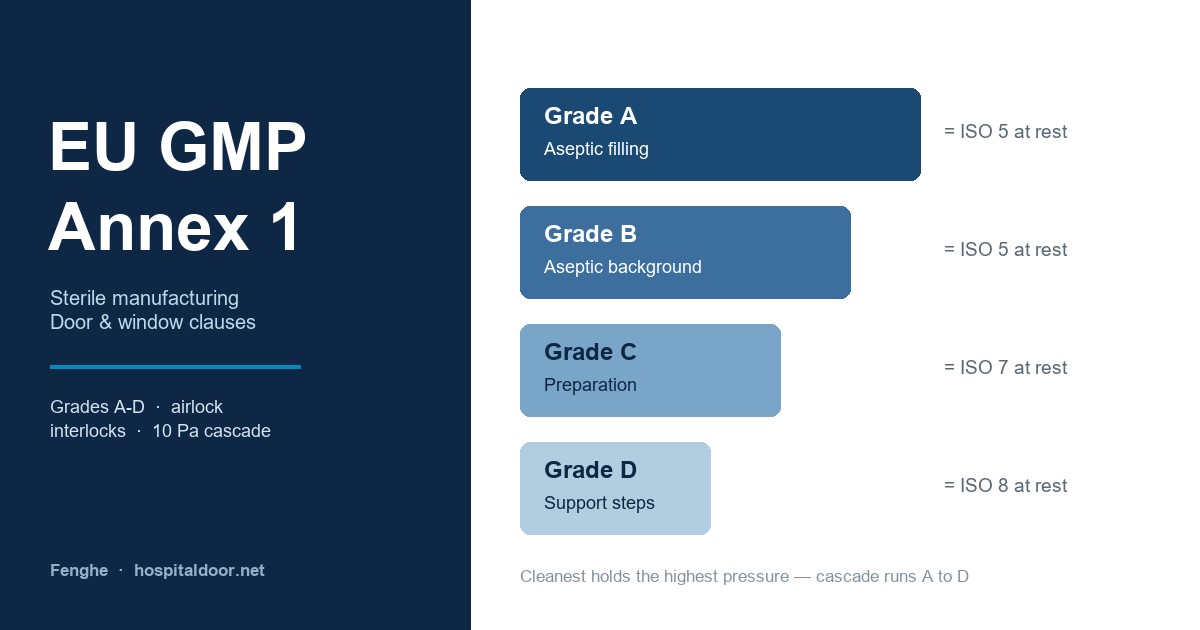
Every GMP cleanroom in a sterile facility is graded by what happens inside it, not by particle counts alone. Grade A is the protected critical zone — filling, sealing — usually inside a Grade B background in an aseptic suite. Grades C and D are the supporting cleanrooms for preparation and less critical handling.
| Grade | Typical role | Closest ISO 14644 equivalent (at rest) |
|---|---|---|
| A | Aseptic filling and sealing, protected zone | ISO 5 |
| B | Background for Grade A operations; aseptic gowning end | ISO 5 |
| C | Preparation of solutions to be filtered | ISO 7 |
| D | Support steps, component prep, less critical handling | ISO 8 |
If you are more used to ISO classes, our ISO 14644 explainer for doors and windows covers that system's nine classes and its own test regime. Annex 1 leans on ISO 14644-1 for classification but adds the GMP logic on top: occupancy states, monitoring, and door discipline.
The Contamination Control Strategy Includes Your Doors
Section 2 of the 2022 revision requires every manufacturer to document a Contamination Control Strategy (CCS) — a single joined-up picture of how contamination is controlled across the facility, and why. Doors and windows appear in it as engineered barriers: each opening in a wall is a potential breach of the cascade, and clause 4.12 asks that the monitoring points and criticality of pressure differentials be documented within the CCS.
In practice, this means a door is no longer just hardware. Its interlock logic, its seal condition, its opening times and its alarm status all become CCS data. Suppliers who can describe their doors in those terms save their customers real documentation work.
Clauses 4.10 and 4.12: Airlocks and Interlocked Doors
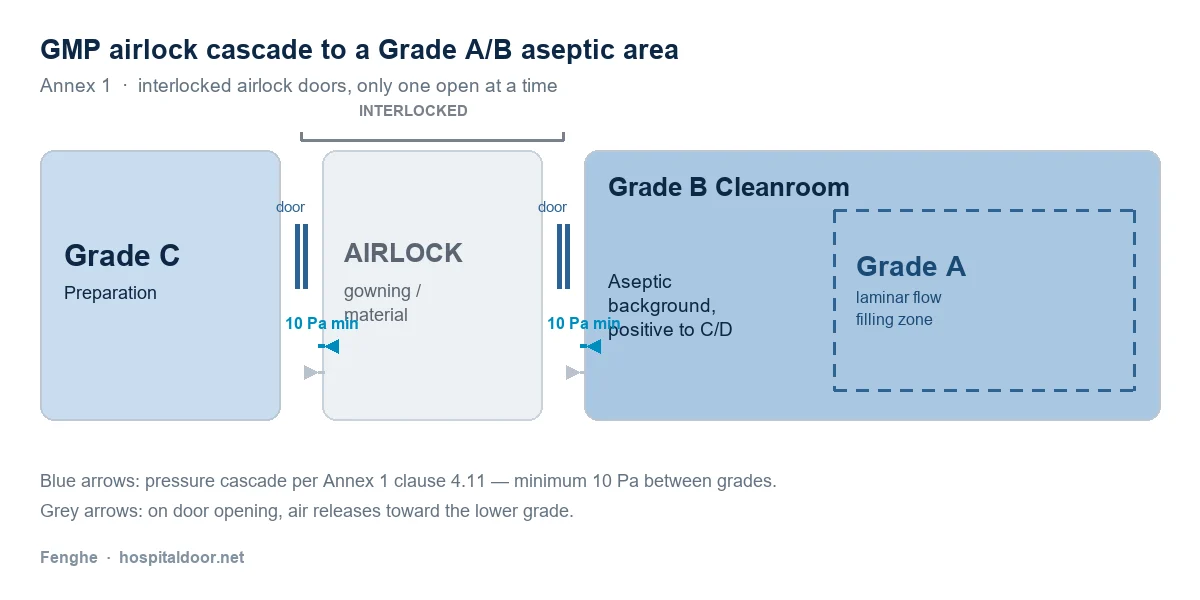
Clause 4.10 sets the baseline: rooms of different grades should not open directly into one another — movement goes through airlocks. The glossary defines an airlock precisely: an enclosed space with interlocked doors, constructed to maintain air pressure control between adjoining rooms.
For airlocks serving Grade A or B areas, interlocking both doors is the accepted reading: only one door can open at a time, and the airlock flushes between openings. For Grade C and D boundaries, the annex does not spell out an alternative — in practice many projects adopt a door-opening control or alarm system instead of physical interlocks, a point worth confirming with your QA. Pass-through hatches for material follow the same logic — both sets of doors must never be open simultaneously.
For door and window suppliers this translates into concrete deliverables: electric or magnetic interlock sets with a proved safety loop, contactors that report door status to the building system, vision panels wide enough for the interlock to be seen and trusted, and emergency-release logic that satisfies both GMP and escape-route rules — the same interlock engineering we apply to cleanroom door projects.
Clause 4.11: The 10 Pa Pressure Cascade
Adjacent rooms of different grades should hold a pressure differential of a minimum of 10 pascals (guidance value) with an appropriate cascade from the cleanest room outward. A Grade B room sits positive to its Grade C surround, which sits positive to the unclassified corridor.
That cascade is only as strong as the leakiest door leaf. A door that leaks around its frame makes the HVAC system chase losses, slows recovery after every opening, and produces pressure alarms that operators learn to ignore. This is why GMP cleanroom projects specify doors by air-permeability class rather than by goodwill: our airtightness classes explainer covers how those ratings read, and hermetic sealing doors with gasketed perimeters are the usual answer at every grade boundary.
Surfaces and Materials: What the Leaf Must Survive
Annex 1 asks for surfaces that are smooth, impervious and easy to clean — and the 2022 text leans harder on sporicidal and vaporised hydrogen peroxide (VHP) disinfection. That narrows the material list for a pharmaceutical cleanroom: powder-coated steel, HPL-faced leaves over closed-cell cores, stainless steel and GRP all work, provided coatings tolerate the disinfectants actually used on site. Our comparison of powder-coated steel versus HPL leaves goes through the trade-offs; VHP compatibility is the question to close before specifying.
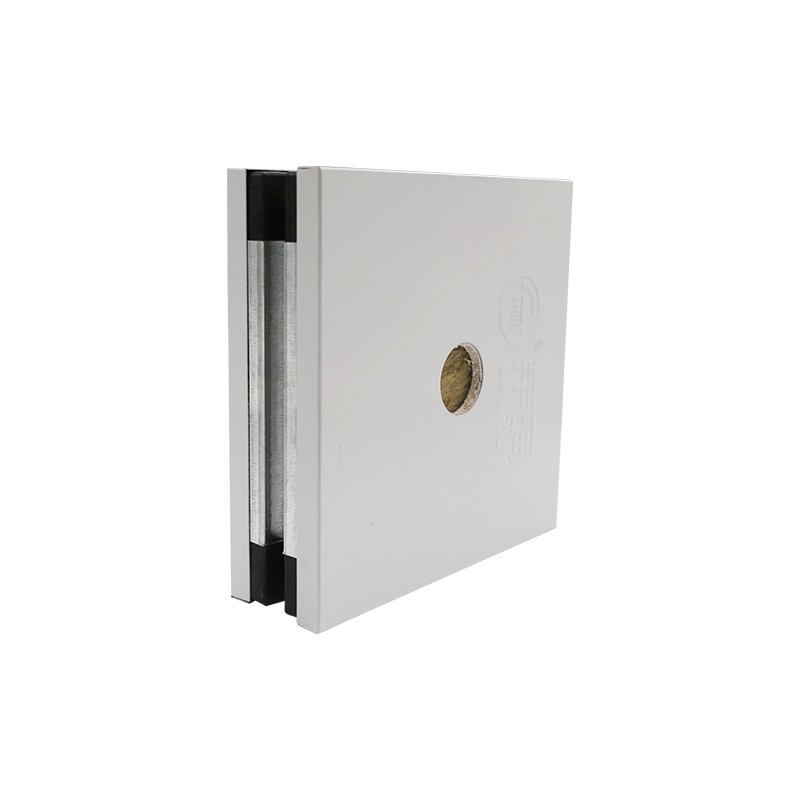
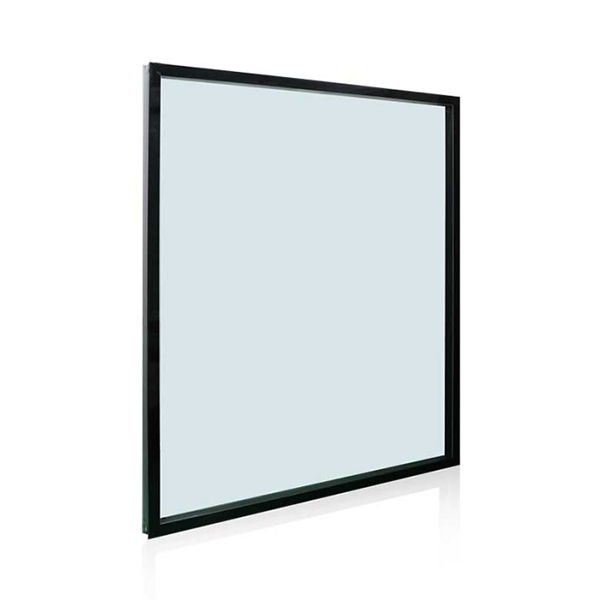
Windows follow the same logic as vision panels: flush double-glazed units sealed into the leaf or wall panel, no ledges, no dust traps. In monitor rooms and corridors, double-glazed observation windows let supervisors watch a Grade A operation without gowning in — a small investment that pays back at every batch review.
Monitoring: Doors That Feed the Data
Clause 4.12 puts pressure differentials into the monitoring regime: values, alarm limits and the criticality of each differential belong in the CCS. Doors contribute more than people expect — interlock status contacts, door-open-too-long alarms and pressure-differential sensor ports through the frame all turn a leaf into a monitoring point. During airflow visualization studies, door-opening cycles are part of the test, so hinge-side seal condition shows up on camera.
What to Ask Your Door Supplier
Because the room is qualified as a system, the right questions are about evidence:
- Interlock logic diagram — what fails safe, what releases in a fire alarm, what the escape route proof is.
- Air permeability class of the complete doorset (frame, leaf, thresholds), not the leaf alone.
- Material compatibility statements for the disinfectants named in your CCS, including VHP.
- Recovery behaviour — how fast the room returns to setpoint after a door cycle, from test reports.
- Documentation: drawings, wiring, certificates, and a commissioning method the QA team can file.
Suppliers who answer in that vocabulary are the ones who have done GMP cleanroom door schedules before — the pharma, CSSD and wider clean room projects we quote all run on it.
GMP Annex 1 FAQ
Is GMP Annex 1 legally binding?
Yes for sterile medicines placed on the EU market, and for any importer or manufacturer inspected against EU or PIC/S rules. Inspectors check compliance with the whole annex, including the door and airlock clauses.
What is the difference between GMP grades and ISO classes?
ISO 14644-1 classifies rooms by airborne particle concentration. GMP grades add the use context: the same ISO 5 room can be Grade A (aseptic core) or Grade B (background) depending on what happens inside it.
Do all cleanroom doors need to be interlocked?
Interlocks are expected at airlocks serving Grade A and B areas. At Grade C and D boundaries many projects run a door-control or alarm system instead — worth confirming with your QA team, since the annex text does not spell this out.
When did the revised Annex 1 take effect?
25 August 2023, replacing the 2008 text. Point 8.123 — loading and unloading of freeze-driers — had until 25 August 2024.