
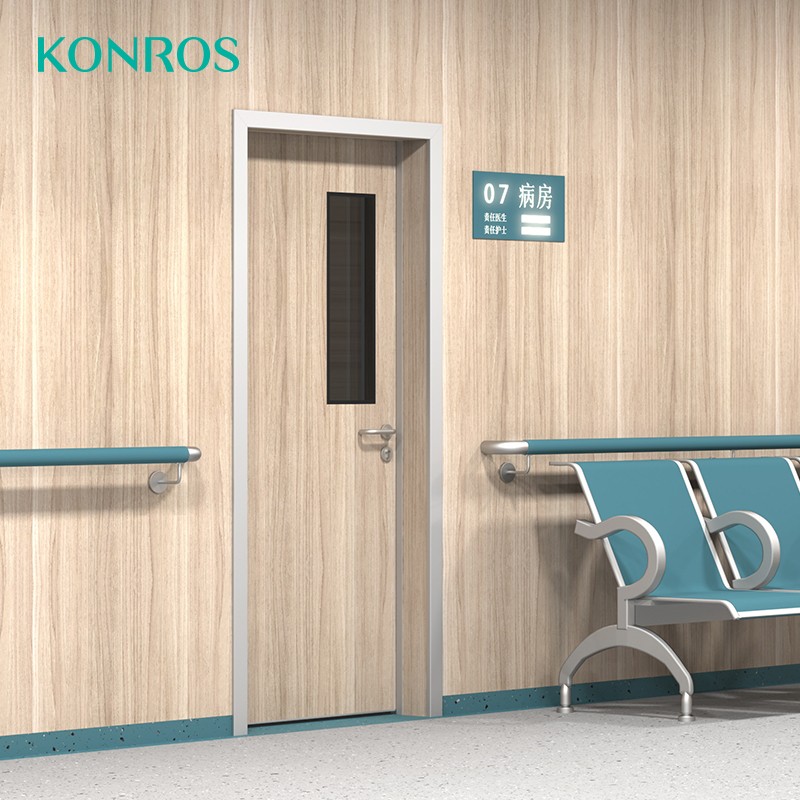
Clean Room Door Interlocking System for Cleanrooms & CSSD
MODEL NO.: FHD-101
HPL hermetic clean room door with interlocking systems for EPS wall panels - color and door-leaf type customizable, ISO certified.
Doors for cleanrooms and controlled environments: fire-rated hermetic assemblies, airtight steel doors for CSSD and pharma areas.
Selecting the right clean room door starts with the contamination control level your facility operates at. Four types cover the full spectrum from ISO Class 5 semiconductor fabs to hospital CSSD departments.
Airtight cleanroom doors use flush-mounted leaves with smooth, crack-free surfaces for ISO 14644 Class 5-8 cleanrooms. The leaf sits level with the wall panel — no recess, no ledge, no particle trap. Perimeter gaskets compress against the frame to maintain pressure differentials of 10-20Pa between cleanliness zones. Available with HPL, powder-coated steel or stainless steel faces.
Hermetic cleanroom doors are automatic sliding assemblies with full-perimeter sealing for pharmaceutical cleanrooms and laboratories where airtightness must be documented. The door closes against a machined frame with a continuous gasket channel, achieving EN 12207 Class 4 airtightness. Brushless DC operator runs on a sealed overhead track outside the clean zone, so no particles enter from the mechanism.
Fire rated cleanroom doors for CSSD face a unique combination: steam sterilizers on one side, clean corridor on the other, and a fire compartment wall between. Our fire-rated cleanroom doors achieve EI30 or EI60 to EN 1634 while maintaining smooth, wipe-clean surfaces compatible with hospital disinfectants. Double-leaf configurations accommodate trolley traffic.
Two-door interlock systems for airlocks and material transfer chambers. Only one door opens at a time, preventing simultaneous exposure of the clean zone to the ambient environment. The controller supports configurable delay, pressure-equalization wait, and integration with room pressure monitors. LED indicators show door status to personnel on both sides.
A cleanroom door is not just a door with a smooth finish. Three properties separate genuine cleanroom doors from standard commercial doors.
First, particle control. Every surface must be non-shedding: no exposed hinges, no crevices, no unpainted edges. The door frame, architrave and threshold must be coved or flush with the wall system. Second, sealability. The door must maintain the room's pressure differential — typically 10-20Pa between adjacent cleanliness classes — without leakage that would compromise the HVAC balance. Third, cleanability. All surfaces must withstand the facility's cleaning protocol: alcohol wipes in electronics cleanrooms, hydrogen peroxide vapor in pharma isolators, or high-temperature steam in CSSD.
Hermetic sliding doors achieve EN 12207 Class 4 (the highest) with continuous compression seals on all four sides. Flush swing doors with perimeter gaskets maintain 10-20Pa differential between ISO classes. Interlock doors include a pressure-equalization cycle before the second door releases. Leakage rates are documented in test reports shipped with each order.
Standard finishes: powder-coated steel (RAL colors, smooth matte), brushed stainless steel 304 or 316 (for CSSD and wet areas), and HPL laminate (for office-adjacent clean zones). All finishes are non-outgassing and compatible with cleanroom-compatible disinfectants. Stainless steel options include electropolished surfaces for ultra-clean Class 5 applications.
Perimeter seals are silicone or EPDM, selected for the cleaning agents used in your facility. Drop-down threshold seals activate automatically when the door closes. Hinges are concealed or full-flush; handles are tapered with no dirt-trap crevices. Vision panels use double-glazed tempered glass flush-mounted with the leaf surface, sealed with sanitary silicone.
GMP-compliant cleanrooms for sterile manufacturing, filling lines and biotech laboratories. Doors integrate with wall systems from the same supplier to ensure continuous sealing and uniform cleanability. Hermetic sliding doors for grade A/B zones; flush swing doors for grade C/D support areas.
Central sterile supply departments need doors that survive daily steam exposure, trolley impacts and aggressive disinfectants. Our CSSD doors use stainless steel or HPL faces with mineral core for fire separation. Double-leaf automatic sliding doors connect the decontamination area to the sterile store, with interlock preventing cross-contamination.
ISO Class 5-7 cleanrooms for PCB assembly, semiconductor packaging and precision optics. Flush doors with minimal particle generation, stainless steel hardware, and interlock systems for material airlocks. Electrostatic dissipative (ESD) surfaces available for sensitive component areas.
Research laboratories, university cleanrooms and testing facilities. Doors configured for the specific contamination control level — from simple flush swing doors for teaching labs to hermetic interlock systems for biosafety level 3 (BSL-3) containment suites.
ISO 14644-1 defines cleanroom classes by the maximum allowable particle concentration per cubic meter. Class 5 (equivalent to former Class 100 / FED-STD-209E) permits 3,520 particles ≥0.5μm per m³; Class 7 permits 352,000; Class 8 permits 3,520,000. The door's role is to maintain this classification when people and materials pass between zones.
For door selection: Class 5-6 typically requires hermetic sliding doors with interlock airlocks; Class 7 can use flush swing doors with good perimeter seals; Class 8 allows standard cleanroom-compatible doors. Your HVAC engineer specifies the pressure cascade; we build doors that hold it.
These three terms overlap but have distinct technical meanings. A clean room door is any door designed for particle-controlled environments — the category includes all types below. An airtight door passes a leakage test (EN 12207) but may not have cleanroom-compatible surfaces. A hermetic door achieves the highest seal class (Class 4) with compression seals on all sides, typically sliding-automatic in operation. In practice: every hermetic door is airtight; every cleanroom hermetic door is both. We use "hermetic" for doors with documented Class 4 sealing and "airtight" for doors with good but not Class 4 sealing.
Cleanroom doors with mineral core achieve 30-minute fire resistance (EI30) to EN 1634-1. 60-minute ratings (EI60) available with thicker cores and intumescent seals. Surface spread of flame: Class B-s1,d0 to EN 13501. CE marking for European projects. Air tightness certified to EN 12207. For pharmaceutical projects, doors support GMP compliance with material certificates and surface finish documentation.
Pricing depends on door type (flush swing vs hermetic sliding vs interlock system), size, finish and fire rating. A single flush swing door costs a fraction of a two-door interlock system with controller. Send your door schedule and cleanroom classification for item-by-item pricing within 48 hours. Standard production 20-35 days. Get a quote.
A door designed for particle-controlled environments: non-shedding surfaces, perimeter seals to maintain pressure differentials, and compatibility with cleanroom cleaning protocols. Includes flush swing doors, hermetic sliding doors and interlock systems.
Hermetic cleanroom doors achieve EN 12207 Class 4 sealing with compression seals on all four sides. Every hermetic door is suitable for cleanrooms, but not every cleanroom door is hermetic. Flush swing doors with gaskets are cleanroom-compatible but not Class 4.
This is set by your process, not by the door. ISO 14644-1 defines particle limits per class. Class 5-6 typically needs hermetic sliding doors with interlocks; Class 7 uses flush swing doors with good seals; Class 8 allows standard cleanroom-compatible doors.
Yes. Mineral-core cleanroom doors achieve EI30 or EI60 to EN 1634-1 while maintaining smooth, cleanable surfaces — critical for CSSD and pharma facilities with fire compartment requirements.
Yes. Two-door interlock systems with configurable delay, pressure-equalization and LED status indicators. The controller integrates with room pressure monitors and access control systems.
Get the latest price? We will reply as soon as possible (within 12 hours)