
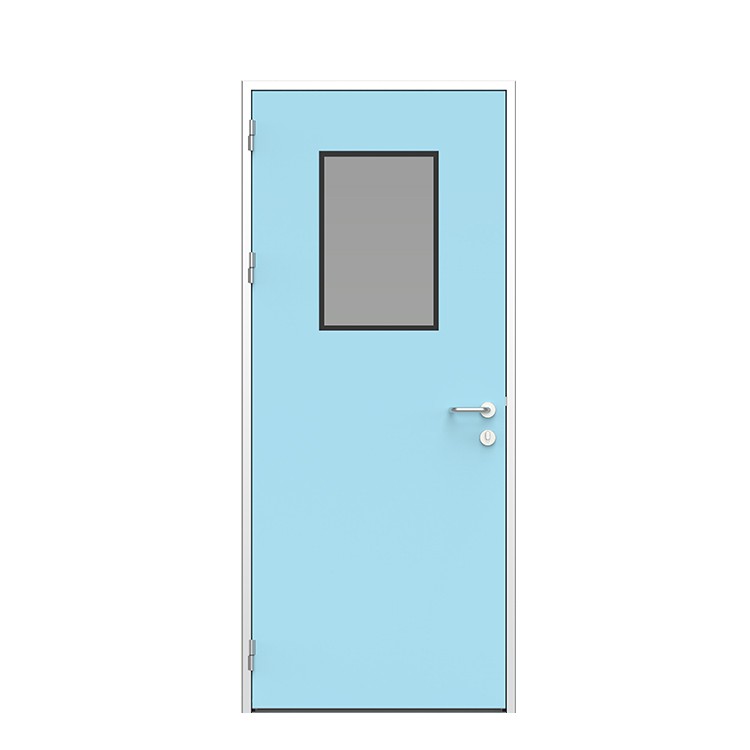
Lead Lined Door for CT Scan Rooms
MODEL NO.: FHD-103
Hospital radiology protection lead door with or without lead glass window for CT scan rooms - HPL finished, antibacterial, custom sizes.
Lead-lined X-ray doors and matched lead glass windows for imaging rooms: 1-3mmPb shielding, manual or automatic, with type-test reports.
MODEL NO.: FHD-103
Hospital radiology protection lead door with or without lead glass window for CT scan rooms - HPL finished, antibacterial, custom sizes.
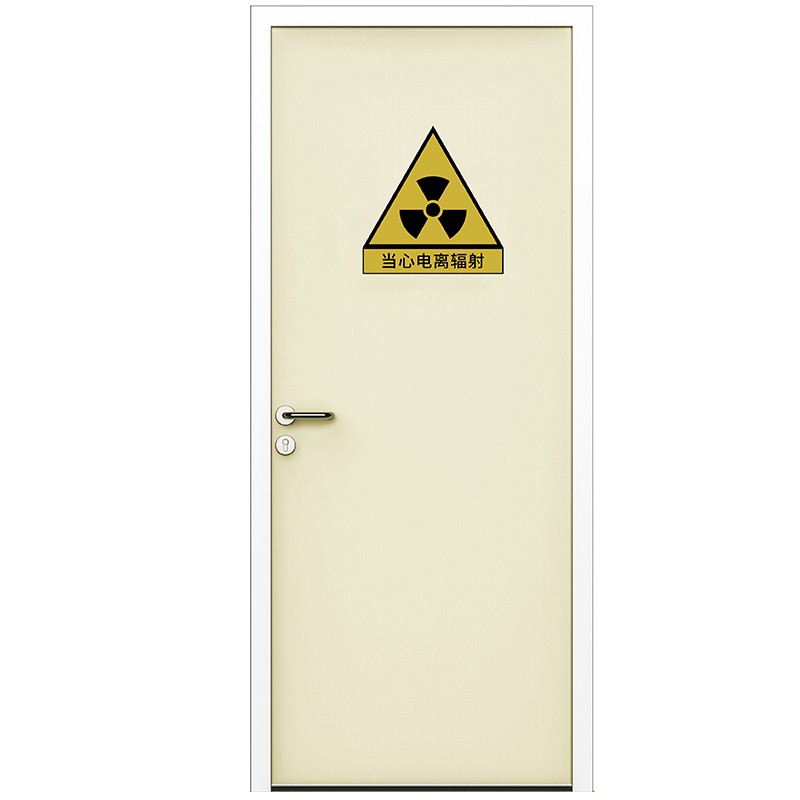
MODEL NO.: FHD-301
Lead lined door for X-ray and radiology rooms - 1.0-3.0mmPb to the shielding report, matched lead glass, IEC 61331 type-test evidence.
Every door in a radiology suite is part of the room's radiation shield. Our lead lined doors are built to the Pb equivalence specified by your physicist — typically 1.0mmPb for general X-ray rooms, 2.0mmPb for CT suites, and up to 3.0mmPb for high-workload fluoroscopy or interventional labs. The lead sheet is bonded between the door core and the finished face, so the door looks and operates like a normal hospital door while stopping scatter radiation.
Single or double-leaf hinged doors for general radiography and digital radiography rooms. HPL or powder-coated finish over lead-lined core, with lead-lined frame and automatic door closer. The lead wraps continuously around the door edge and into the frame overlap, eliminating leakage paths at the hinge and latch sides.
Hermetic-sealed automatic sliding doors with lead-lined leaves for CT scanner rooms and adjacent control corridors. The operator runs on a sealed overhead track that never enters the shielded zone, and the door closes against a lead-lined rebated frame for continuous protection. Brushless DC motor with battery backup for emergency opening.
Wide-opening double-leaf doors for linear accelerator rooms and catheterization labs where equipment and stretchers need clear passage. Both leaves carry matched lead equivalence; one leaf can be held open with a flush bolt during maintenance, then closed to restore full shielding integrity.
Radiation shielding is designed as a complete envelope — walls, ceiling, floor, viewing window, and door. If the door does not match the wall's Pb equivalence, it becomes the weakest link and scatter radiation finds it. This is why radiation physicists specify door shielding in the same report as wall shielding, and why building departments inspect door lead coverage during commissioning.
A radiation protection door must address three leakage paths: the leaf itself (continuous lead sheet, no gaps), the gap between leaf and frame (lead-lined architrave or rebated overlap), and the gap under the door (automatic drop seal or lead-lined threshold). We engineer all three into every door we build, and our type-test reports document the measured leakage at each interface.
Lead equivalence is specified by your radiation physicist based on equipment workload, room geometry and occupancy factors. Common values: 1.0mmPb for chest X-ray and dental, 1.5mmPb for general fluoroscopy, 2.0mmPb for CT scanners, 2.5–3.0mmPb for interventional radiology and cardiac cath labs. We build to the exact Pb value on your shielding report — no standard sizes, no guessing.
Frames are lead-lined to match the door leaf, with a minimum 15mm overlap between door edge and frame lead. The architrave (door surround) carries the same lead equivalence as the wall, ensuring no unprotected gap at the wall-to-frame junction. Hinges, locks and closers are mounted through the lead — not around it — so fastener holes are backed with lead washers.
Vision panels in radiation doors use lead glass with Pb equivalence matching the door leaf — typically 1.5–2.7mmPb depending on the glass thickness. The window frame overlaps the door lead on all four sides, and the glass is sealed with radiation-absorbing silicone. We supply lead glass windows as part of the door package, not as a separate order. Browse observation windows.
General X-ray rooms need 1.0mmPb manual swing doors with lead glass vision panel — the most economical configuration. CT suites typically use 2.0mmPb automatic sliding doors for the patient entrance and 2.0mmPb swing doors for the control-room intercom/viewing area. Mammography rooms often need only 0.5mmPb because the workload is low and the beam is directed. Dental and veterinary X-ray rooms use narrow single doors with minimal shielding. Nuclear medicine and PET scan rooms require heavier shielding (2.5–3.0mmPb) due to higher energy isotopes.
Every radiation protection door ships with a type-test report documenting the measured radiation attenuation at the specified kVp, tested to IEC 61331-1 or the equivalent national standard. The report covers the door leaf, frame overlap and lead glass window individually, and is the document your physicist submits for regulatory compliance.
Additional documentation available with each order: material certificates for the lead sheet (purity and thickness), factory test reports for door function (opening force, closing speed, cycle count), and installation drawings showing lead coverage zones. CE marking is available for projects requiring it.
Lead lined doors are priced by Pb equivalence, leaf size and operator type. A 1.0mmPb manual swing door costs significantly less than a 2.0mmPb automatic sliding door with matched lead glass — but both are a fraction of the total room shielding cost. Send your shielding report and door schedule for item-by-item pricing within 48 hours. Standard production runs 20-35 days. Request a quote with your drawings.
Your radiation physicist specifies this from the equipment workload and room geometry. Typical values: 1.0mmPb for general X-ray, 2.0mmPb for CT, 2.5-3.0mmPb for interventional labs. We build to the exact value on your shielding report.
Yes. Lead glass windows are supplied as part of the door package with matching Pb equivalence, sealed frame and type-test documentation — not ordered separately.
The lead sheet itself is 1.0-3.0mm depending on Pb equivalence. The total door leaf thickness is 40-50mm including core, lead and face material — similar to a standard hospital door.
Yes. Every radiation door ships with a type-test report to IEC 61331-1 or equivalent, documenting measured attenuation for the leaf, frame and window. This is the document your physicist needs for regulatory compliance.
Yes. Send photos and measurements of the existing door and frame. We confirm the Pb equivalence, leaf size and hardware positions before quoting — no original drawings needed.
Get the latest price? We will reply as soon as possible (within 12 hours)