How to Choose Hermetic Doors for Operating Rooms: A Buyer's Guide
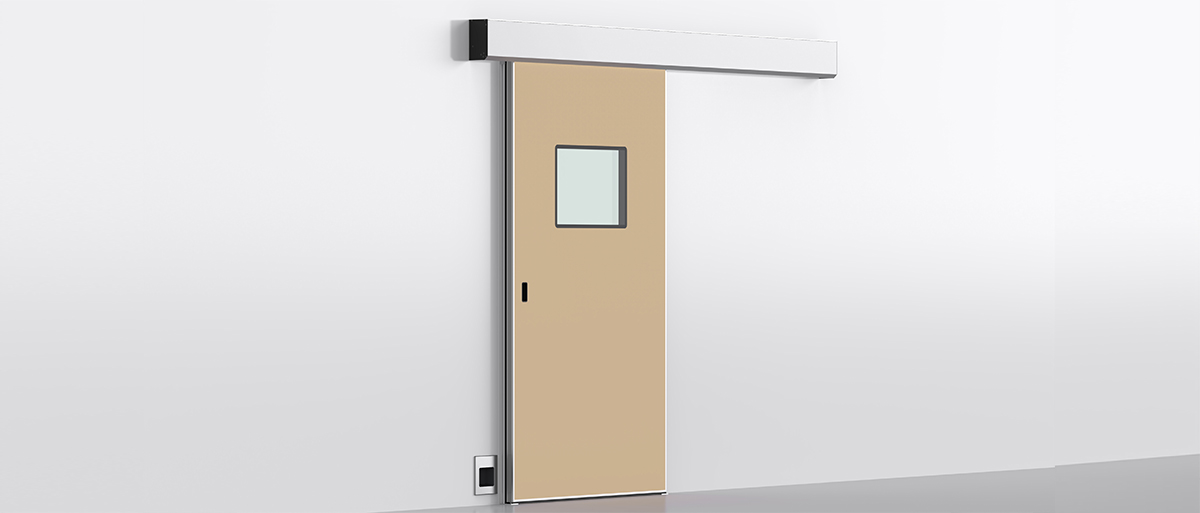
Hermetic sliding doors are the single most visible piece of the operating room envelope. They are opened hundreds of times a day, cleaned with aggressive agents, and expected to hold pressure regimes that protect patients. Choose well at procurement and the door disappears into daily routine; choose badly and it becomes a permanent line item on the maintenance budget.
Start with the seal, because that is what you are actually buying
A genuine hermetic door seals the full perimeter: brush or blade gaskets on both jambs and the head, a labyrinth or compression detail at the leading edge, and a raised bottom rail the leaf closes onto. When the door shuts, the leaf should compress onto those seals - you can hear the difference, and you can measure it. A leaf that merely parks next to a brush is a sliding door with decoration.
Ask any supplier for the air leakage figure behind the word "hermetic". The honest answer is a test report under EN 12207 showing leakage at stepped pressures, in a class you can compare across vendors. A brochure adjective is not a specification.
The operator decides how the door behaves in an emergency
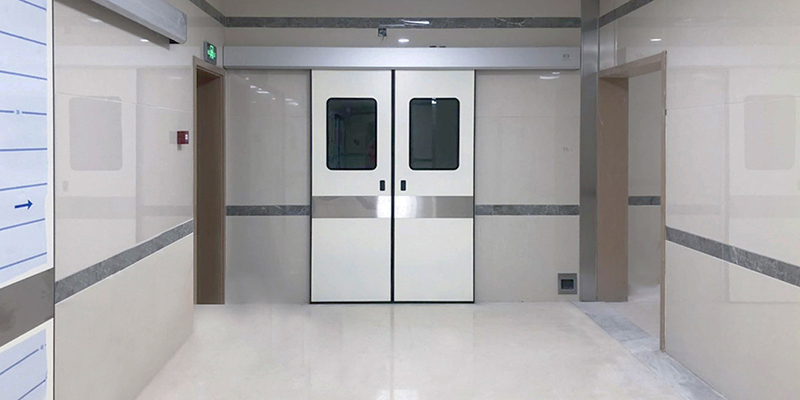
The motor matters as much as the leaf. Brushless 24V DC operators with belt drives have become the default in theatres for boring, good reasons: they run quietly, shed heat well, and tolerate the cycle counts of a busy surgical department. Check the rated leaf weight against your actual leaf - a fully glazed or lead-lined leaf can weigh twice what a standard leaf does, and an undersized operator will show it within a year.
Then ask the unglamorous questions. What happens on power failure - does the door fail safe on battery, and for how many cycles? Can the leaf be pushed open by hand in an emergency? Does the breakout function actually release, and has anyone tested it on your site rather than in the factory?
Hygiene is in the details, not the brochure photo
Look at the leaf surface: it should be flush, free of exposed screws, and resistant to the disinfectants your infection-control team actually uses. Vision panels belong sealed into the leaf as double glazing with anti-fog treatment - a surface-mounted window that fogs during a four-hour procedure has stopped doing its job. Handles should be stainless where they exist at all; radar and foot control remove most of the touching.
Documentation is part of the door
A theatre door that passes commissioning in Germany answers to DIN 1946-4 ventilation practice; in the UK the reference is HTM 03-01; automatic operation answers to EN 16005. None of that is your job to master - but the supplier who volunteers the paperwork for all three is the supplier who will not vanish when the commissioning engineer starts asking questions.
What we would check before signing any quotation
- Sealing: full-perimeter compression, EN 12207 leakage report on the table.
- Operator: rated for the real leaf weight, battery backup specified in cycles.
- Activation: radar plus foot control as standard, presence sensors in the safety field.
- Glazing: double, sealed in, anti-fog treated.
- Spares: seal sets and rollers priced with the door, not after it.
Pressure regimes protect patients; the door protects the pressure regime. Buy the seal, not the signage.
Mistakes we see on repeat at tender stage
- Specifying "hermetic" without a class or figure - two suppliers can both claim the word and differ by a factor of five in leakage. The number is the specification.
- Operator sized for the catalogue leaf - then the project adds lead lining or glazing and the motor spends its life at the limit.
- Forgetting the wall pocket - hermetic frames need prepared openings; discovering this at installation costs weeks.
- Vision panels specified as single glazing to save pocket change, fogging for the next fifteen years.
- Activation ordered as radar-only - then wondering why sterile staff shoulder the door open during procedures.
Related terms you will meet in specifications
Theatre door schedules travel with a small vocabulary: airtight sliding door, gas-tight door, hermetic doorset, clean door, OT door, operating theatre sliding door. They circle the same product family; what separates them is never the noun and always the leakage figure behind it. When a consultant's schedule uses "gas-tight", read it as a request for evidence at the EN 12207 pressure steps - and answer with the report.
FAQ
What is the difference between a hermetic door and an airtight door?
In hospital practice they describe the same performance, seen from two angles: "airtight" is the measured property (leakage through the closed door), "hermetic" implies the compression mechanism that achieves it - the leaf clamps onto full-perimeter seals when it closes. Ask for the test report under either name.
How long do hermetic door seals last?
Seals are consumables. In a busy theatre, expect gasket inspection quarterly and replacement every few years depending on cycles and cleaning agents. Budgeting seals and rollers as maintenance items - not warranty items - keeps the leakage class honest for the life of the door.
Do operating room doors need to be automatic?
Not by universal law, but by practical necessity: beds, monitors and sterile hands make manual theatre doors a workflow bottleneck and a contact point. Radar plus foot control is the accepted package; manual override remains available for power loss.
Can a hermetic door also be fire-rated or lead-lined?
Yes - as a tested assembly. The doorset carries fire classification (EN 13501 family) and lead shielding to the physicist's plan simultaneously, but every element must be part of the tested, certified set. Mixing unrated hardware into a multi-function door unravels all three claims.
What maintenance does a theatre door need?
Monthly cleaning and seal inspection, quarterly sensor and safety checks, annual measurement of closing force, leakage sanity and battery behaviour. The door's logbook is the cheapest insurance in the department.
What the best-specified projects do differently
Across theatre door schedules, the projects that commission cleanly share habits: they write the leakage class into the tender instead of the word "hermetic"; they order spare seals and rollers with the doorsets; and they rehearse the commissioning walk with the ward manager present, not just the installer. None of it costs more at order stage - all of it costs less forever after. The door is a machine; the best projects treat the paperwork as part of the machine.
Are hermetic doors the same as gas-tight doors?
Interchangeable in most clinical specifications - "gas-tight" is the containment-laboratory idiom for the same low-leakage performance. Both should answer to the same evidence: leakage class, pressure steps, configuration-matched report.
What is the lead time for hermetic operating room doors?
Typical factory-direct cadence runs four to six weeks for standard hermetic sets after drawing confirmation, longer for lead-lined or breakout programmes, plus freight. The schedule's critical path is almost always the signed drawing, not the factory floor.
Do theatre doors need stainless steel faces?
HPL and coated steel are the theatre norms; stainless earns its place at the harshest cleaning regimes. The clinical requirement is sealed, non-shedding faces that survive the agents - material choice follows the ward's chemistry.
Can a hermetic door be installed in a drywall partition?
With the right framing preparation - a structural pocket or reinforced studwork per the manufacturer's details. The leaf compresses against its frame; the frame must push back, so the wall and the door are specified together or not at all.
Specify the seal, demand the number, rehearse the failure. Everything else in a theatre door purchase is decoration around those three acts.